Most home solar panel installations in Ireland are limited to an inverter power of 5.5 kW, under ESB Networks rules. It's possible to get permission for a larger inverter under a process called NC7, but the application fee alone costs around €1000, and it's not guaranteed to be accepted. So most Irish home solar panel installations are limited to 5.5 kW for the inverter in practice.
Many think that this means there's not much point installing more than perhaps 10 or 11 kW of panels, thinking that the inverter will be too much of a "bottleneck". I call this the "Clipping Problem Narrative".
The "Clipping Problem" Narrative
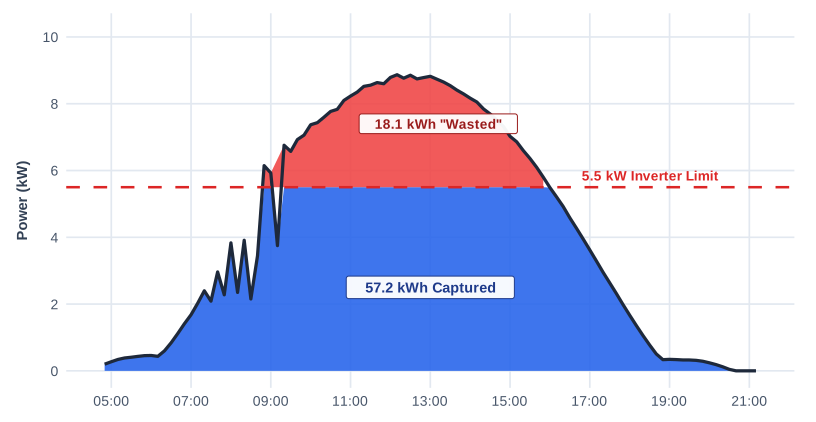
People arguing against a solar PV array that's much bigger than the inverter capacity will show you a graph like the one above. The graph purports to show that the extra capacity was "wasted" by clipping. The chart is based on real data, but the presentation is extremely misleading.
This article will explain why. And it will also explain why it's worth having not only 10, 11, or 12 kW, but sometimes even 20+ kW of solar panels on a mere 5.5 kW inverter. I've come to this conclusion by looking hard at the numbers, using meteorological data from Met Éireann and simulations of how different-size solar panel arrays perform over the course of a year. But first, a bit of context.
The Solar Panel Power Rating Mirage
Solar panels are rated based on their power output in a lab test, where the conditions (1000 Watts of sunlight per m²) roughly match a tropical desert on a cloudless day at noon. Not typical Irish weather.
In Ireland, 100 to 500 W/m² is more usual. Under these conditions, a 5.5 kWp solar array produces only about 0.6 to 2.2 kW. That's well below the inverter's capacity, meaning the panels, not the inverter, are usually the limiting factor on power output in Ireland.
Here's how the numbers play out across two real Irish days of weather, one sunny and one cloudy.
Sunny Day
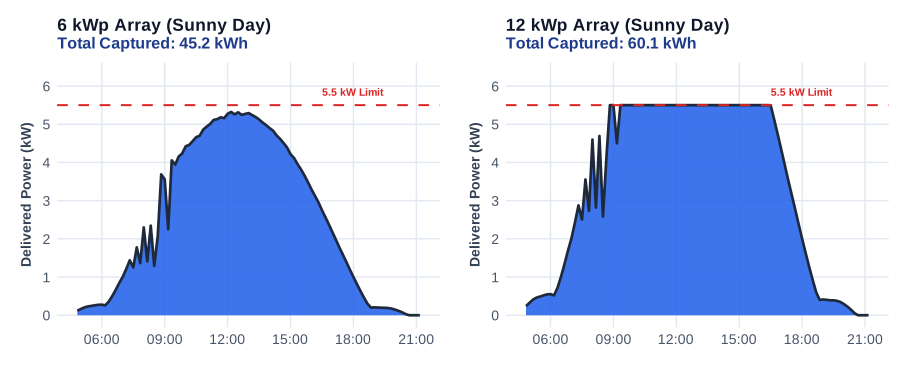
The system with more panels produces 33% more useful energy over the course of the sunny Irish day, despite clipping. The uplift would be far greater on a battery system, where generation above 5.5 kW can be fed into the battery rather than getting clipped.
Cloudy Day
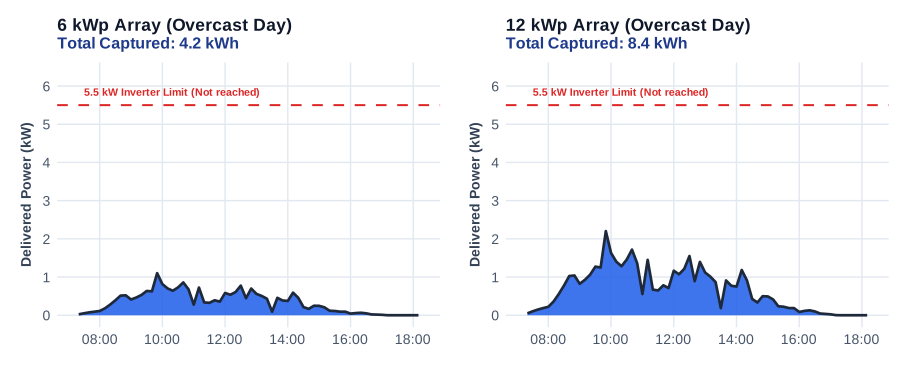
On the October day shown above, the (so-called) 12 kWp solar panel array never gets above about 2.4 kW. The inverter does not at any point become the bottleneck, and therefore the 12 kWp array delivers exactly double the electricity of the 6 kWp system.
Let's see how the numbers play out as we add ever more panels to the same 5.5 kW inverter. The chart that follows is again based on real Irish weather data, this time covering the entire year of 2023.
Annual Delivered Electricity vs Solar Panel Array Size With 5.5 kW Inverter (No Battery)
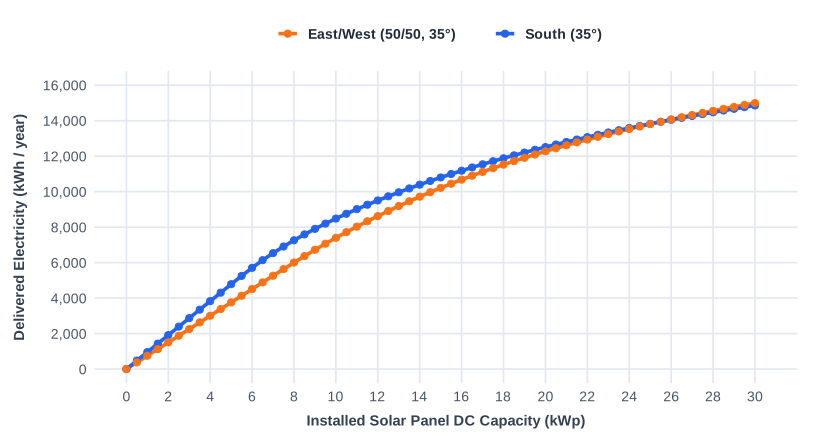
Total delivered electricity climbs steeply for each additional panel added, and the effect continues way beyond the 5.5 kWp "limit". Even at 15 kWp of panels on a mere 5.5 kW inverter, each additional panel still provides significant extra annual output.
East/West split roofs are particularly well suited for oversizing because generation is more spread out across the day. In the extreme case, an East/West system will produce more energy over the course of a year than a South-facing system of the same size, as its generation will be more spread out over the course of the day and so suffer less from clipping.
And keep in mind that the above chart is for a system without a battery. Adding a battery would result in far more energy capture for the oversized systems...
The Battery Loophole Lets You Capture Even More Energy
The 5.5 kW inverter limit in Ireland applies to the AC electricity output. There's no such limit on the combined electricity across AC output and battery charging direct from solar.
For example, it's perfectly allowable to have 8 kW output from your solar panels, with 5.5 kW going to the grid and 2.5 kW going into a DC-coupled battery.
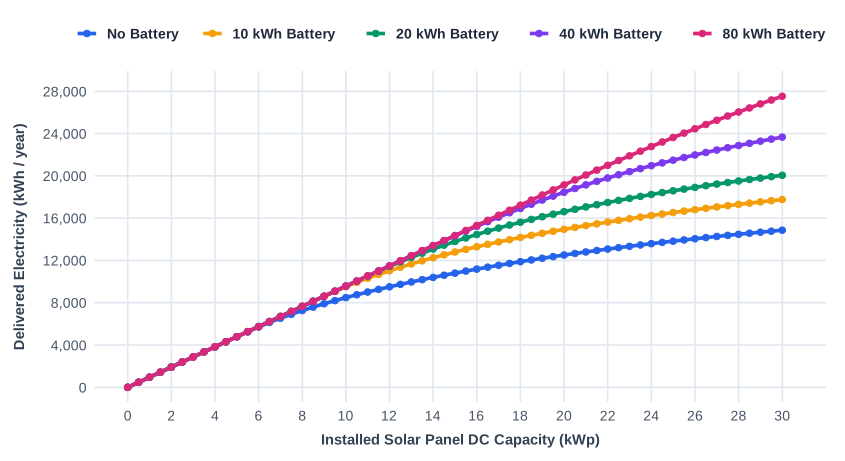
As the chart below shows, the greater the battery capacity, the higher the quantity of panels that can be installed before the inverter becomes too much of a bottleneck. Already in 2026, it's common to have a 20 kWh battery, making about 18 kW of panels viable on a 5.5 kW inverter even today.
Annual Energy from 5.5 kW Inverter With Different Battery & Solar Array Sizes
The Economics: Payback on Each Marginal kW of Panels
The cost of a solar panel installation includes a lot of fixed overhead: scaffolding, electrical work, certification, and grant administration. But once the installers are on site it often costs relatively little to add extra panels. For the following calculations, we'll use a figure of €700 per additional kWp installed (or roughly €300 per additional panel).
The tables include optimistic (30 cent per kWh), pessimistic (10 cent per kWh), and medium (20 cent per kWh) views on the value of the additional electricity generated.
On a South-Facing Roof (35° Pitch) in Tipperary
| Added Capacity | Total kWh Delivered / Year | Marginal kWh Delivered / Year | Marginal Cost | Payback @ 10c/kWh | Payback @ 20c/kWh | Payback @ 30c/kWh |
|---|---|---|---|---|---|---|
| 6th kWp | 5,708 kWh | 924 kWh | €700 | 7.6 yrs | 3.8 yrs | 2.5 yrs |
| 7th kWp | 6,536 kWh | 828 kWh | €700 | 8.5 yrs | 4.2 yrs | 2.8 yrs |
| 8th kWp | 7,260 kWh | 724 kWh | €700 | 9.7 yrs | 4.8 yrs | 3.2 yrs |
| 9th kWp | 7,904 kWh | 644 kWh | €700 | 10.9 yrs | 5.4 yrs | 3.6 yrs |
| 10th kWp | 8,484 kWh | 580 kWh | €700 | 12.1 yrs | 6.0 yrs | 4.0 yrs |
| 11th kWp | 9,014 kWh | 530 kWh | €700 | 13.2 yrs | 6.6 yrs | 4.4 yrs |
| 12th kWp | 9,506 kWh | 491 kWh | €700 | 14.3 yrs | 7.1 yrs | 4.8 yrs |
| 13th kWp | 9,965 kWh | 459 kWh | €700 | 15.2 yrs | 7.6 yrs | 5.1 yrs |
| 14th kWp | 10,396 kWh | 431 kWh | €700 | 16.2 yrs | 8.1 yrs | 5.4 yrs |
| 15th kWp | 10,802 kWh | 405 kWh | €700 | 17.3 yrs | 8.6 yrs | 5.8 yrs |
| 16th kWp | 11,183 kWh | 381 kWh | €700 | 18.4 yrs | 9.2 yrs | 6.1 yrs |
| 18th kWp | 11,884 kWh | 341 kWh | €700 | 20.5 yrs | 10.3 yrs | 6.8 yrs |
| 20th kWp | 12,513 kWh | 306 kWh | €700 | 22.9 yrs | 11.5 yrs | 7.6 yrs |
On a 50:50 East/West Split Roof (35° Pitch) in Tipperary
| Added Capacity | Total kWh Delivered / Year | Marginal kWh Delivered / Year | Marginal Cost | Payback @ 10c/kWh | Payback @ 20c/kWh | Payback @ 30c/kWh |
|---|---|---|---|---|---|---|
| 6th kWp | 4,510 kWh | 752 kWh | €700 | 9.3 yrs | 4.7 yrs | 3.1 yrs |
| 7th kWp | 5,261 kWh | 751 kWh | €700 | 9.3 yrs | 4.7 yrs | 3.1 yrs |
| 8th kWp | 6,005 kWh | 744 kWh | €700 | 9.4 yrs | 4.7 yrs | 3.1 yrs |
| 9th kWp | 6,724 kWh | 720 kWh | €700 | 9.7 yrs | 4.9 yrs | 3.2 yrs |
| 10th kWp | 7,398 kWh | 673 kWh | €700 | 10.4 yrs | 5.2 yrs | 3.5 yrs |
| 11th kWp | 8,029 kWh | 632 kWh | €700 | 11.1 yrs | 5.5 yrs | 3.7 yrs |
| 12th kWp | 8,626 kWh | 597 kWh | €700 | 11.7 yrs | 5.9 yrs | 3.9 yrs |
| 13th kWp | 9,189 kWh | 563 kWh | €700 | 12.4 yrs | 6.2 yrs | 4.1 yrs |
| 14th kWp | 9,718 kWh | 529 kWh | €700 | 13.2 yrs | 6.6 yrs | 4.4 yrs |
| 15th kWp | 10,214 kWh | 496 kWh | €700 | 14.1 yrs | 7.1 yrs | 4.7 yrs |
| 16th kWp | 10,679 kWh | 465 kWh | €700 | 15.0 yrs | 7.5 yrs | 5.0 yrs |
| 18th kWp | 11,527 kWh | 411 kWh | €700 | 17.0 yrs | 8.5 yrs | 5.7 yrs |
| 20th kWp | 12,274 kWh | 362 kWh | €700 | 19.3 yrs | 9.7 yrs | 6.4 yrs |
On a South-Facing Roof (35° Pitch) with a 20 kWh DC-Coupled Battery
| Added Capacity | Total kWh Delivered / Year | Marginal kWh Delivered / Year | Marginal Cost | Payback @ 10c/kWh | Payback @ 20c/kWh | Payback @ 30c/kWh |
|---|---|---|---|---|---|---|
| 6th kWp | 5,743 kWh | 957 kWh | €700 | 7.3 yrs | 3.7 yrs | 2.4 yrs |
| 7th kWp | 6,700 kWh | 957 kWh | €700 | 7.3 yrs | 3.7 yrs | 2.4 yrs |
| 8th kWp | 7,658 kWh | 957 kWh | €700 | 7.3 yrs | 3.7 yrs | 2.4 yrs |
| 9th kWp | 8,615 kWh | 957 kWh | €700 | 7.3 yrs | 3.7 yrs | 2.4 yrs |
| 10th kWp | 9,572 kWh | 957 kWh | €700 | 7.3 yrs | 3.7 yrs | 2.4 yrs |
| 11th kWp | 10,523 kWh | 951 kWh | €700 | 7.4 yrs | 3.7 yrs | 2.5 yrs |
| 12th kWp | 11,434 kWh | 911 kWh | €700 | 7.7 yrs | 3.8 yrs | 2.6 yrs |
| 13th kWp | 12,286 kWh | 852 kWh | €700 | 8.2 yrs | 4.1 yrs | 2.7 yrs |
| 14th kWp | 13,078 kWh | 792 kWh | €700 | 8.8 yrs | 4.4 yrs | 2.9 yrs |
| 15th kWp | 13,795 kWh | 717 kWh | €700 | 9.8 yrs | 4.9 yrs | 3.3 yrs |
| 16th kWp | 14,454 kWh | 659 kWh | €700 | 10.6 yrs | 5.3 yrs | 3.5 yrs |
| 18th kWp | 15,618 kWh | 554 kWh | €700 | 12.6 yrs | 6.3 yrs | 4.2 yrs |
| 20th kWp | 16,614 kWh | 480 kWh | €700 | 14.6 yrs | 7.3 yrs | 4.9 yrs |
Based on 1-minute climate data from Met Éireann at Gurteen weather station for 2023. Yields are modelled with reflection, low-light, temperature, cabling and inverter losses included; 2023 was around 2.6% sunnier than the long-run average for the site.
Clearly, not only is the 10th or 11th kWp not a waste, but the 15th, and in some cases even the 20th kWp can also be justified, even in the context of a 5.5 kW inverter "bottleneck".
Real-World Catch: Finding the Right Inverter
While the economics favour oversizing, equipment availability presents a real-world challenge. As of 2026, it can be hard to find a 5.5 kW single-phase solar inverter that explicitly allows connecting more than 10 kWp of panels.
There's a grey area in many inverter manufacturer datasheets. Many list the "maximum recommended PV array power" rather than a hard cap. Irish solar installers are often comfortable installing 11 or 12 kWp of panels on an inverter that has a "recommended" maximum of 10 kWp. But my sense is that most would be hesitant at 15 kWp.
Hard electrical boundaries are typically much more clear and must always be respected for safety reasons. These include the inverter’s maximum open-circuit voltage (Voc) and maximum short-circuit current (Isc) limits.
I believe it's time for an inverter manufacturer to offer a 5.5 kW inverter that specifically allows 15+ kW of panels to be attached, and to promote it on the Irish market on that basis.
The Takeaway: Fill Your Roof
If you are installing solar panels in Ireland, don't let the fear of "clipping losses" hold you back from installing 10, 14, or even 18 kW of panels. The scaffolding is up, the electrician is on site, and panel hardware is cheap: fill your roof and let the extra capacity work for you year-round.
Use the interactive Solar Panel Oversizing Calculator to simulate your own roof orientation, inverter rating, and DC battery setup.